
Better Sleep for Neurodivergent Kids: What Actually Works for ADHD and Autism
By Liz Harden, MPH
This is Post 2 of a three-part series on neurodivergence and sleep. Post 1 covers the neurobiology behind why ADHD and autism affect sleep. Post 3 covers specific sleep conditions that disproportionately affect neurodivergent children and are frequently missed.

Most sleep advice wasn’t written with neurodivergent children in mind. The strategies that work for the kid next door may not work for your child, and there’s a biological reason for that. If you want to understand that reason more deeply, Post 1 of this series covers the neuroscience. But you don’t need to have read it to benefit from what’s here.
This post is about what actually helps. The fundamentals of healthy sleep still apply for neurodivergent children. Consistent timing, a predictable routine, and enough movement during the day still matter. What changes is how deliberately and patiently you apply them, and how much you account for the unique way your child’s brain and nervous system work.
Changing too much at once can feel overwhelming for any child, and especially for neurodivergent children who depend on predictability and routine to feel safe. Pick one or two things that feel most relevant to your child right now and start there. Small, consistent changes tend to add up in ways that can feel almost surprising.
How to Support Your Neurodivergent Child’s Internal Clock
Getting the timing right matters for every child, but for neurodivergent children it deserves particular attention. When sleep pressure and the internal clock are aligned, everything else gets a little easier.
Among the behavioral strategies for supporting the internal clock, consistent morning wake time is one of the most well-supported starting points. Clinical guidelines for children with ADHD and autism specifically recommend keeping wake time consistent, including on weekends. [1] When wake time shifts around significantly from day to day, the circadian rhythm drifts, and falling asleep at a predictable time becomes harder for everyone.
For children with delayed circadian phase, and Post 1 covers how common this is in ADHD and autism, the goal isn’t necessarily an earlier bedtime. A bedtime that actually aligns with when the child’s brain is biologically ready for sleep, paired with a consistent wake time, tends to work better than nightly battles over a bedtime the body isn’t ready for. Your child’s physician can help you figure out whether the bedtime itself needs to shift.
Light is one of the most accessible tools for supporting the internal clock, and the evidence is particularly interesting for children with ADHD. Research shows that morning bright light exposure can advance melatonin onset over time, essentially nudging the internal clock a little earlier. [2] Outdoor morning light isn’t as intense as a clinical light therapy lamp, but it’s a reasonable starting point and worth building into the morning routine where possible.
Evening light as it naturally fades signals to the brain that sleep is approaching. An evening walk covers a lot of ground at once: gentle movement, natural light transition, fresh air, and time together. Bright artificial light and screens in the hour before bed work in the opposite direction, telling the brain it’s still daytime. Dimming the lights throughout the house in the evening, not just in the bedroom, makes a real difference. [3]
How to Set Up the Sleep Environment for a Sensory-Sensitive Child
For many children, setting up a dark, cool, quiet room is enough. For neurodivergent children, the sleep environment often needs a more intentional look. Research confirms that sensory processing differences and sleep are closely connected: hypersensitivity increases arousal and prolongs sleep onset, and environmental factors like noise and lighting can overwhelm a sensitive child in ways that lead to bedtime resistance and frequent night wakings. [4] This relationship is more pronounced in neurodevelopmental conditions than in the general population.

A useful question to ask: has anyone ever looked at your child’s sleep space through a sensory lens?
Darkness and Temperature
The basics still apply. A dark room and a cool temperature support the body’s natural sleep processes. Blackout curtains make a real difference. Check the edges too, where light tends to creep in. The body needs to drop its core temperature to fall asleep, which means the room should feel cool. Cozy is fine. Warm is not. That said, families in warmer climates and some cultural contexts may have different baselines.
Sound
Sound is one of the most individual variables in the sleep environment. White noise works well for many children because it masks household sounds that might otherwise cause startling. For some neurodivergent children, white noise is activating rather than calming. If it hasn’t been working for your child, trying alternatives is a reasonable next step: pink noise, brown noise, or binaural beats. Some children do best in silence. Some experimentation is usually part of the process.
Fabrics and Textures
Research specifically identifies tactile sensitivity as a potential contributor to sleep problems in children with autism. [4] How do the pajamas feel? How do the sheets feel? A tag, a seam, a fabric that is too slippery or too rough can be enough to prevent a sensory-sensitive child from settling. Seamless pajamas and softer bedding options are reasonable things to explore if texture seems to be a factor.
Weighted Blankets
Weighted blankets are widely used in clinical practice for children with sensory processing differences and ADHD, and many families find them helpful. A randomized controlled crossover trial found improvements in sleep for children with ADHD using weighted blankets. [5] The evidence base is still developing, but the clinical rationale is sound: the deep pressure input they provide can support the nervous system in settling. They are not right for every child, and trying one before committing is a good idea where possible. An occupational therapist with sensory processing expertise can provide individualized guidance.
The Rest of the Environment
Bed size, bed location, and proximity to noise sources all deserve a deliberate look. The principle is sound: if a child is sensitive to sensory input, reviewing the environment systematically is a logical place to start.
How to Build a Bedtime Routine That Works for a Neurodivergent Child
Research shows that children with regular, consistent routines fall asleep sooner and wake less during the night. [6] For neurodivergent children, the foundations are the same. What changes is how much structure, patience, and visual support a child may need to actually access those benefits.
For children with ADHD and autism, bedtime is a transition. For autistic children specifically, the research points to heightened arousal, sensory dysregulation, and difficulty adapting to environmental cues as the reasons bedtime changes feel so stressful. Understanding this changes how we approach the routine.
Build In Enough Time for the Wind-Down
Once you’ve established a bedtime that aligns with your child’s biology, protect the time leading up to it. For neurodivergent children, the wind-down process often takes longer than parents expect. Think of it less as moving bedtime earlier and more as starting the transition sooner. A gradual slowing of activity and stimulation before the routine formally begins gives the brain time to shift rather than being expected to switch off suddenly.
Preview What’s Coming
Before the routine begins, let your child know what’s ahead. “In ten minutes we’re going to start getting ready for bed. First we’ll do bath, then pajamas, then books.” This kind of advance notice reduces the surprise of the transition and gives the child time to prepare mentally. Countdowns help too.
Keep It Consistent
The same steps, in the same order, every night. This is how the brain learns that sleep is coming. For children who struggle with transitions, the familiarity of the sequence itself becomes a source of safety.
Use Visual Supports Where Helpful
For autistic children in particular, visual schedules are well supported by research as a tool for improving on-task behavior and reducing frustration during transitions. [7] A simple bedtime routine chart with pictures of each step in order can reduce the need for repeated verbal prompting and give the child a sense of control. Match the support to the child’s developmental level rather than their chronological age.
Morning Routines Matter Too
A consistent morning routine also matters. For many neurodivergent children, the shift from sleep to wakefulness is hard. Building in time and predictability at the start of the day supports regulation throughout it.
Why Movement and Sensory Input Matter for Neurodivergent Sleep
Physical activity supports sleep for all children. For neurodivergent children, the relationship goes a layer deeper.
Research shows that physical activity interventions improve sleep quality in autistic children specifically. A randomized controlled trial found that increasing moderate-to-vigorous physical activity improved sleep quality in autistic children over six months. [8] A meta-analysis spanning over 3,000 children with neurodevelopmental conditions found consistent positive effects of physical activity on regulation and mental health outcomes. [9] The 60-plus minutes of daily movement recommended for all children applies here too, and arguably matters even more.

For many neurodivergent children, movement serves a deeper purpose than physical tiredness. Wiggling, spinning, jumping, climbing, pushing, and pulling are all sensory-seeking behaviors that some kids need to experience during the day in order to feel regulated by the time bedtime arrives.
What that looks like varies considerably from child to child. Some kids need roughhousing and heavy physical activity. Some need spinning or swinging. Some settle best with cuddles and deep pressure. If your child has a prescribed sensory diet from an occupational therapist, try to make sure it’s completed before the calming phase of the bedtime routine begins. An unmet sensory need will work against even the most consistent routine.
If there’s one thing that works across almost every age and profile, it’s an evening walk. It combines gentle movement, fading natural light that supports melatonin onset, fresh air, and time together as a family. One of the most practical recommendations for almost any family, regardless of age or schedule.
Co-Regulation at Bedtime: Why the Caregiver’s State Matters
There is a piece of the bedtime puzzle that conventional sleep advice rarely addresses. It has to do with the caregiver in the room.
Children feel the emotional state of their caregiver. Research on emotional availability at bedtime shows that greater caregiver presence and attunement is associated with fewer night wakings and better sleep continuity in children. [10] For neurodivergent children, who often have greater difficulty with emotion regulation than their neurotypical peers, the caregiver’s regulated presence at bedtime is part of the strategy.
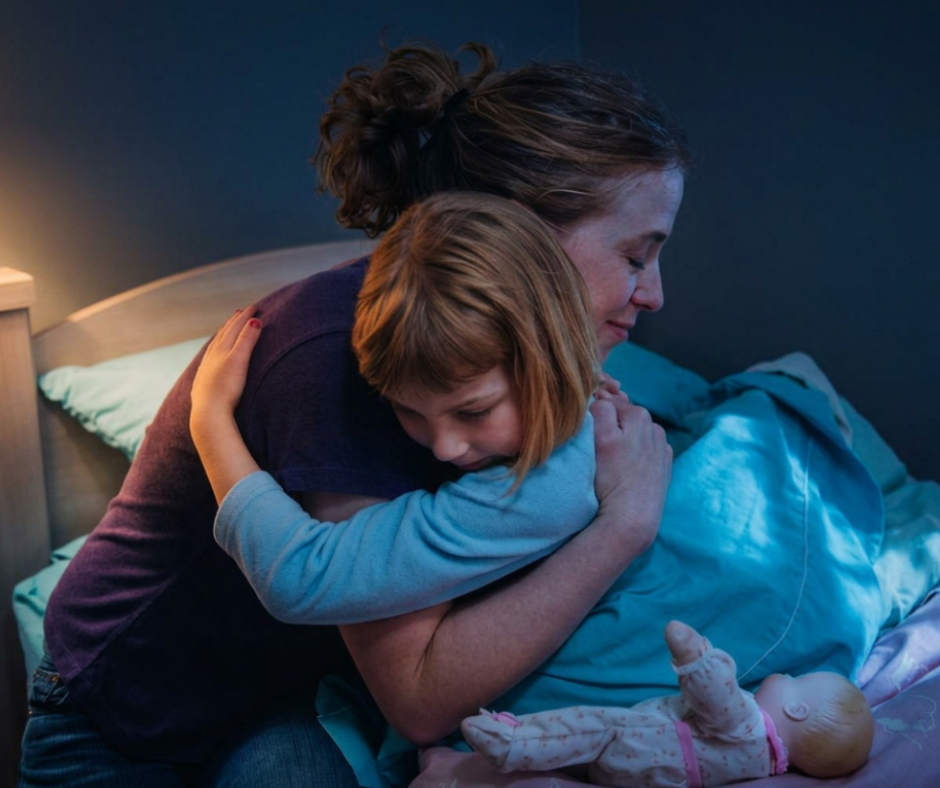
Co-regulation, the process by which a calm, present caregiver helps a child’s nervous system settle, is particularly important for anxious and hypervigilant children. Research with neurodivergent adolescents found that co-regulation and the ability to express distress without stigma were central to emotional wellbeing, alongside stable, trusting relationships and predictable routines. [11] The bedtime routine is one of the most powerful opportunities in the day for that kind of connection.
Parenting a neurodivergent child is demanding in ways that are hard to overstate. By the time bedtime arrives, many caregivers are running on empty. That’s not a personal failing. It’s an honest reflection of how much these families carry. And it matters for sleep, because a depleted, dysregulated caregiver at bedtime communicates that state to the child, making settling harder for everyone.
Simple things help. A few slow breaths before walking through the bedroom door. Stepping outside for a moment. A brief pause to transition out of the day before the routine begins. We wrote a full post on this if you want to go deeper:
Just Be There: Why Your Presence Is the Most Powerful Bedtime Sleep Tool You Have.
A note for providers: When you’re working with a neurodivergent child whose sleep hasn’t responded to environmental or behavioral interventions, the caregiver’s state at bedtime is part of the picture. A parent who is chronically dysregulated at bedtime is working against the child’s ability to settle, regardless of how consistent the routine is.
Melatonin for Children with ADHD and Autism: What the Research Shows
Melatonin comes up a lot in conversations with families of neurodivergent children. When sleep is consistently hard and you’re exhausted, a supplement that might help is an understandable option to explore.
Here’s what the research shows.
Melatonin supplementation is widely used in children with ADHD and autism, and clinical bodies including the Mayo Clinic note that it may be recommended for children with these conditions when managed with routine evaluation by their healthcare team. [12] For autistic children specifically, a two-year randomized controlled trial found significant improvements in sleep with no adverse effects on growth or puberty. [13] The evidence base is more robust for autism than for ADHD, where the research is still developing.
A few things to know before reaching for it:
Melatonin is not FDA regulated in the United States. It’s classified as a dietary supplement, which means products are not tested for safety, effectiveness, or label accuracy before they’re sold. Studies have found actual melatonin content in supplements ranging from significantly less to significantly more than what’s listed on the label. If you’re going to use it, product quality matters.
Immediate release melatonin is designed to support sleep onset, not sleep maintenance. It isn’t formulated to last through the night, so it’s unlikely to help with frequent night wakings. Extended release formulations exist and are sometimes considered for children who wake frequently, but availability and quality vary considerably in the US. This is a conversation to have with your child’s physician, who can guide which formulation makes sense for your child specifically.
Timing matters significantly. Getting it wrong can work against the sleep you’re trying to support, which is one reason melatonin works best as part of a thoughtfully timed plan rather than a standalone fix.
Melatonin works best when the sleep foundations are already in place. For many families, strengthening those foundations first produces better results than adding a supplement to an otherwise inconsistent sleep situation.
The conversation about whether melatonin is right for your child belongs with their physician, who can guide appropriate use based on your child’s specific needs.
Where to Start
Sleep with a neurodivergent child is rarely a straight line. Progress happens, and then a new school year starts, or a developmental leap hits, or the routine falls apart over a holiday and it feels like you’re back at square one. The foundations you’ve built don’t disappear. They just need to be rebuilt, and they come back faster the second time.
The most important thing is to start somewhere. Pick one area that feels most relevant to your child right now. Maybe it’s the timing, maybe it’s the environment, maybe it’s protecting that wind-down window. Work on that consistently before adding anything else. Small changes, held over time, tend to add up.
Post 3 covers what’s happening when even the foundations aren’t enough. There are specific conditions that disproportionately affect neurodivergent children, including some that are frequently mistaken for behavioral problems. Knowing what to look for can change the conversation with your child’s care team entirely.
Frequently Asked Questions
What is the best bedtime routine for a child with ADHD?
The honest answer is that there isn’t one universal routine that works for every child with ADHD. Temperament, sensory needs, age, and family life all shape what actually helps. What the research does support is starting the wind-down earlier than feels necessary, keeping the sequence consistent night after night, and building in advance notice before each transition. Starting earlier doesn’t mean targeting an earlier lights-out time. For many children with ADHD, the biologically appropriate bedtime is actually later than what families have been fighting for, because the internal clock runs later. Starting the wind-down sooner means beginning the transition earlier, not moving the finish line. Dimming lights and reducing stimulation well before the formal routine begins gives the ADHD brain time to shift gears rather than being expected to switch off suddenly. A visual routine chart can reduce the need for repeated verbal prompting and give the child a sense of predictability and control. Beyond that, what works varies considerably from child to child, which is why a routine that works beautifully for one child with ADHD may do very little for another.
How do I get my autistic child to sleep?
Start with the sleep environment. For autistic children, sensory factors like the feel of bedding, the level of darkness, and the type of sound in the room can be significant contributors to sleep difficulty. Once the environment is assessed and adjusted, focus on a consistent, predictable routine with advance notice before each transition. Visual schedules are particularly effective for autistic children. If sleep onset is consistently late despite a good environment and routine, melatonin dysregulation may be a factor to discuss with your child’s physician.
What kind of weighted blanket is best for a child with sensory processing differences?
The evidence on weighted blankets for neurodivergent children is still developing, but they are widely used in clinical practice and many families find them helpful. The commonly recommended starting point is a blanket weighing around 10% of the child’s body weight, though some children prefer more or less pressure. Material matters too: some children find certain fabrics activating rather than calming. Because responses vary considerably, trying before committing is a good idea where possible. An occupational therapist with sensory processing experience can provide individualized guidance on whether a weighted blanket makes sense for your child specifically.
Should I use white noise for my neurodivergent child?
White noise works well for many children because it masks unpredictable household sounds that might otherwise cause waking. For some neurodivergent children, however, white noise is activating rather than calming. If it hasn’t been helping, alternatives like pink noise, brown noise, or silence are all reasonable things to try. What works is highly individual and some experimentation is usually part of finding the right environment for a specific child.
How does physical activity affect sleep in neurodivergent children?
Research consistently shows that regular physical activity improves sleep quality in children with ADHD and autism. For neurodivergent children, movement often serves a deeper purpose than physical tiredness: it supports nervous system regulation in ways that help the body arrive at bedtime in a more settled state. The timing matters too: vigorous activity too close to bedtime can be activating. An evening walk that combines gentle movement with fading natural light is one of the most practical recommendations for almost any family, regardless of age or schedule.
Ready for Support?
Every child deserves stellar sleep, including yours.
I specialize in complex cases and families who need an approach built around their child, not a pre-packaged plan. Schedule a free introductory call and we’ll talk through what’s going on and whether working together feels like a good fit.
If you’re a provider, clinician, or educator who works with neurodivergent children and their families, I’d welcome a conversation about how we might work together. Whether that’s training, referral partnerships, consulting, or something else entirely, there are several ways to collaborate. Schedule an introductory call and let’s talk.

About the Author
Little Dipper Wellness was founded by Liz Harden, MPH, a certified pediatric sleep coach, public health-trained educator, and certified mindfulness and yoga instructor. With over a decade of clinical experience, Liz specializes in individualized, evidence-based sleep support for families, including those who haven't found success with traditional approaches.
She and her team also offer provider training, speaking, and consulting for pediatric providers, early intervention teams, and family-centered professionals. Her approach is grounded in current sleep science and responsive to each family's unique needs, values, and circumstances.
Because every human deserves stellar sleep.
References
This article draws on the following peer-reviewed research:
Nationwide Children’s Hospital. Clinical practice guideline: Behavioral insomnia of childhood. Nationwide Children’s Hospital Clinical Guidelines.
Luu, W., & Fabiano, G.A. (2025). Bright light therapy for children with ADHD and sleep difficulties. Frontiers in Psychiatry.
Lok, R., et al. (2025). Light exposure and circadian rhythms in children. The Lancet Child and Adolescent Health.
Lane, S.J., Leão, T.F., & Spielmann, V. (2022). Sensory processing and sleep difficulties in children. Frontiers in Psychology.
Lönn, M., et al. (2024). The efficacy of weighted blankets for sleep in children with attention-deficit/hyperactivity disorder: A randomized controlled crossover trial. Journal of Sleep Research, 33(2), e13990. https://doi.org/10.1111/jsr.13990
Mindell, J.A., et al. (2009). A nightly bedtime routine: Impact on sleep in young children and maternal sleep and mood. Sleep, 32(5), 599-606. https://doi.org/10.1093/sleep/32.5.599
Delemere, E., & Dounavi, K. (2017). Parent-implemented bedtime fading and positive routines for children with autism spectrum disorders. Journal of Autism and Developmental Disorders, 48(4), 1002-1019. https://doi.org/10.1007/s10803-017-3398-4
Shen, B., et al. (2024). Effects of physical activity interventions on sleep in children with autism spectrum disorder. Frontiers in Pediatrics.
Liang, X., et al. (2024). Physical activity and sleep in children with neurodevelopmental conditions: A meta-analysis. Sleep Medicine Reviews.
Keys, E., et al. (2018). Parent’s emotional availability at bedtime and child sleep. Frontiers in Psychiatry.
Pavlopoulou, G., et al. (2025). Co-regulation and wellbeing in autistic adolescents. Scientific Reports.
Mayo Clinic Health System. (2024). Melatonin for children: What parents need to know.
Malow, B.A., et al. (2021). Sleep, growth, and puberty after 2 years of prolonged-release melatonin in children with autism spectrum disorder. Journal of the American Academy of Child and Adolescent Psychiatry, 60(2), 252-261. https://doi.org/10.1016/j.jaac.2020.07.921